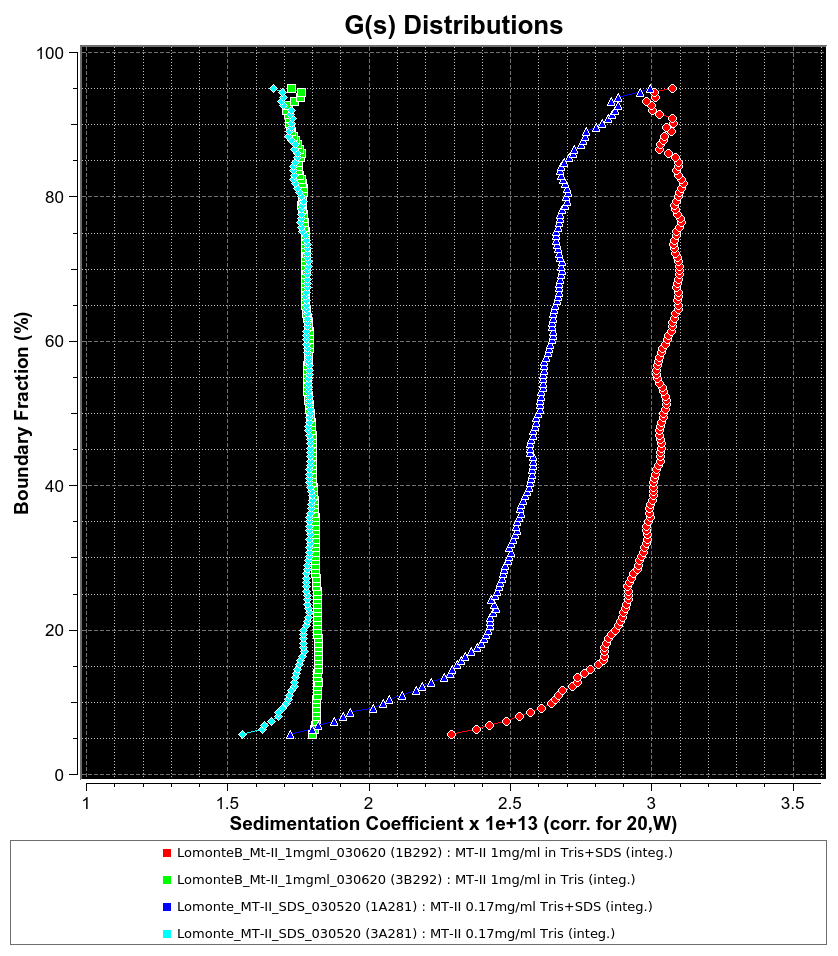
Dear all, Amy ran the most recent samples from Bruno in the presence of 1 mg/ml SDS at two protein concentrations (1 mg/ml and 0.17 mg/ml). The results are quite consistent with the results in Susumu's paper. We do see oligomerization, with a more or less final state. At this point I am not clear if it is a dimer or trimer or something higher, this still needs to be determined. But it is very clear that SDS has a big effect on dimerization. What also is interesting is that the association behavior induced by SDS appears to be reversible. That is, you get dissociation of the oligomer in response to lowering the concentration. We will further test this by using even lower concentration to see if we can shift to entirely monomer. We will also do D2O density matching to see if there is a density difference between monomer and dimer and potentially higher oligomers due to different ratios of SDS binding to myotoxin-II. Now we need to come up with a strutural explanation why this oligomerization shift is happening in response to addition of SDS. I would also like to know if some other lipids could cause the same effect as a detergent? A figure is attached that shows the sedimentation distribution, it looks like similar values as those obtained for the different toxin in the Uchiyama paper. Regards, -Borries

participants (6)
-
Ana Gisele da Costa Neves Ferreira
-
Borries Demeler
-
Bruno Lomonte
-
Hazendonk, Paul
-
Henrickson, Amy
-
Montina, Tony