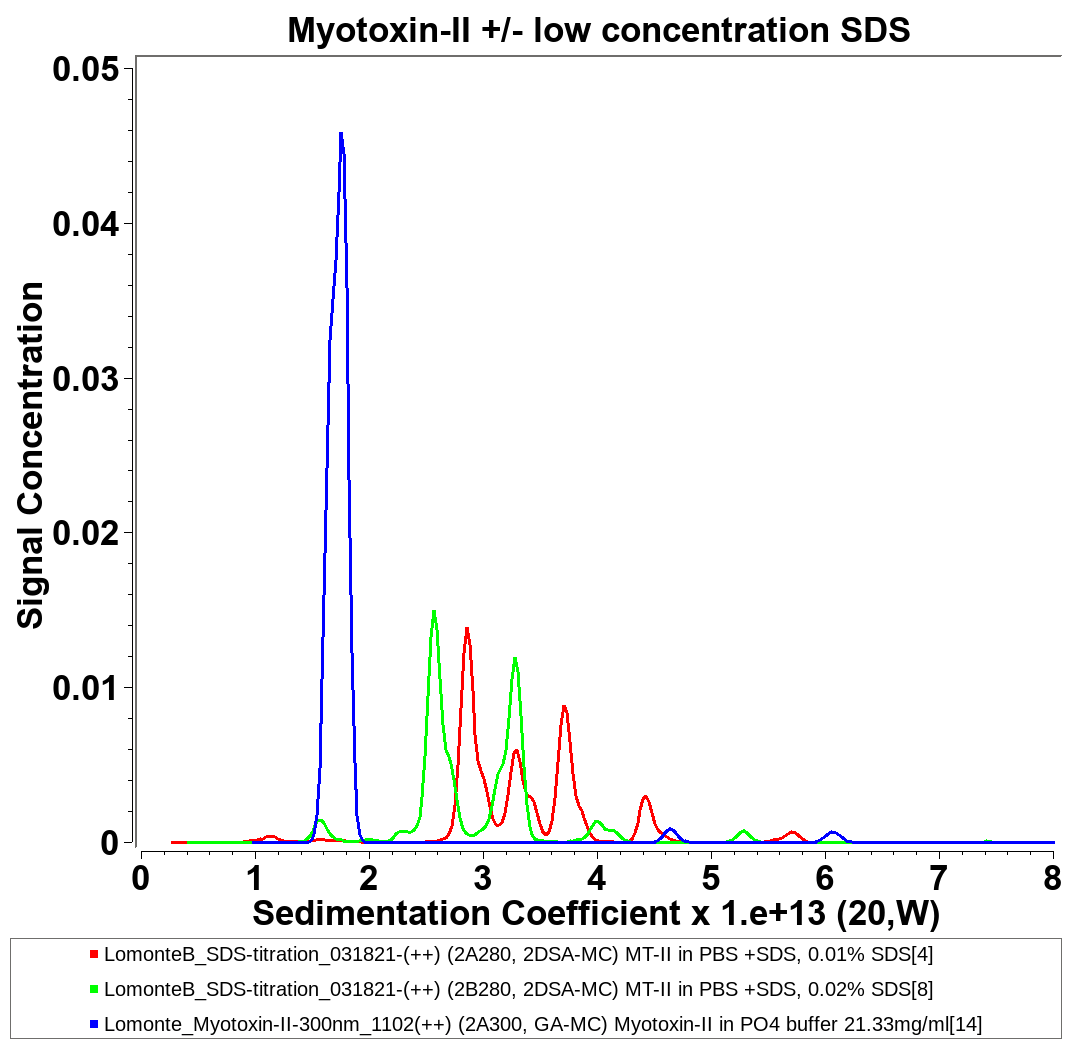
As promised, here is an update on the SDS titration experiment. Amy found plenty of Myotoxin for doing these experiments in our freezer and performed an AUC experiment doing a titration with very low concentration of SDS (0.01 and 0.02 percent of SDS, which should be well below the CMC of SDS). This clearly shows that there is a significant change in the sedimentation profile (see attached). A few notes: 1. The monomer control was actually run at 300 nm with ~21 mg/ml concentration - so very high, and no evidence of dimerization there. The protein concentration in the SDS titration experiments was much, much lower at only about 10 uM. 2. even the 0.01% SDS sample exhibits significant shift in the s-values which can only be explained by dimerization (as seen in the SDS-PAGE), not by micelle formation with multiple myotoxin molecules being incorporated into the micelle. 3. The 0.02% SDS concentration sample sedimented *slower* than the 0.01% SDS sample. If I think about this it makes sense if we assume that instead of additional oligomerization we simply bind more SDS to the complex, because SDS could significantly affect friction. It also affects the partial specific volume. It is less dense than protein so the overall partial specific volume of the complex becomes less dense as more SDS is bound. 4. There isn't just one peak visible, consistent with either monomer or dimer, but there are at least 2 major peaks in both samples, suggesting possible even high order structures than dimer are present, or at least some equilibrium between at least two oligomeric structures. It is not clear to me what oligomers are present, but with a little additional AUC work we could probably figure this out. I think this brings up more questions, but also answers one important question for Paul and Tony: We can definitely significantly reduce the SDS concentration to avoid the strong overlay signals from SDS in the NMR experiments. Also, we can keep the very low phosphate concentration (5mM). I think before we go to the next NMR experiments I want to do one more AUC experiment: Amy, can you please find out the lowest possible SDS concentration that causes a shift for a given protein concentration? What I found surprising is that the 0.02% solution sedimented slower than the 0.01%, this suggests the formation of discrete species, with tight SDS binding, and no change in oligomerization between the two SDS concentrations. That's important. I would like to know if we can find out the lowest SDS concentration that causes this behavior. I think the SDS binds very tightly, so do we see the same behavior at 0.001% SDS? I think we should do a titration one order of magnitude lower, and at the same time increase the protein concentration. THis would tell us two things: 1. what is the best ratio of high concentration protein and low concentration SDS that clearly starts showing this oligomerization? That ratio would be best for NMR, maximum protein signal, minimum SDS signal. Let's find the critical ratios with AUC. We may have to run the SDS titration with more points and also repeat it at multiple protein concentrations. I would also like to know the maximum s-value shift that can be observed, and whether the 2-peak pattern persists. Paul/Tony: What protein concentration would you like to run ideally? 1 mg/ml, 10 mg/ml, 20 mg/ml? Since Bruno is willing to send more sample, I think we can play with this ratio a bit. Amy, how much is left? For AUC I would prefer not to go much above 20 mg/ml to avoid concentration dependent non-ideality effects. Let me know what y'all think about this approach. -Borries